Is 8000mAh enough to get through a day?
The number on the front of a powerbank is not the amount of charge that reaches your phone. Here is the arithmetic, and what capacity you actually need.
The capacity printed on a powerbank is the cell capacity, not the energy that reaches your phone. Converting between voltages loses some along the way, so expect roughly 60 to 70 percent of the printed figure to arrive.
Doing the arithmetic
An 8000mAh bank delivers somewhere near 5,000mAh in practice. A modern phone battery is around 4,000 to 5,000mAh.
So 8000mAh is one full phone charge plus a useful reserve. That is a day out, a long commute, a flight. It is not a weekend of camping.
- 5000mAh → a partial top-up. Pocketable, genuinely useful as an emergency reserve.
- 8000 to 10000mAh → one full charge plus margin. The sweet spot for daily carry.
- 20000mAh → two to three phone charges, or a small laptop top-up. Heavy, and airline rules start to matter.
Output matters more than capacity
A large bank that trickles power at 5W is worse company than a smaller one at 22.5W. Check the output rating, and check wireless separately: 15W MagSafe and 22.5W over Type-C are different paths with different speeds.
Also check whether it can charge and be charged at once. Many cannot.
Safety is not optional
Lithium cells fail badly when they fail. A BIS certification means the unit has been tested against Indian safety standards. Airlines also cap what you can carry, usually at 100Wh, and an 8000mAh bank sits well below that.
The extras worth paying for
Some features are genuinely useful rather than marketing. A magnetic grip that holds the phone in place while charging wirelessly, so you can still use it. A screen showing an actual percentage rather than four ambiguous LEDs. And, if you are going to be waiting anyway, something to do while you wait.
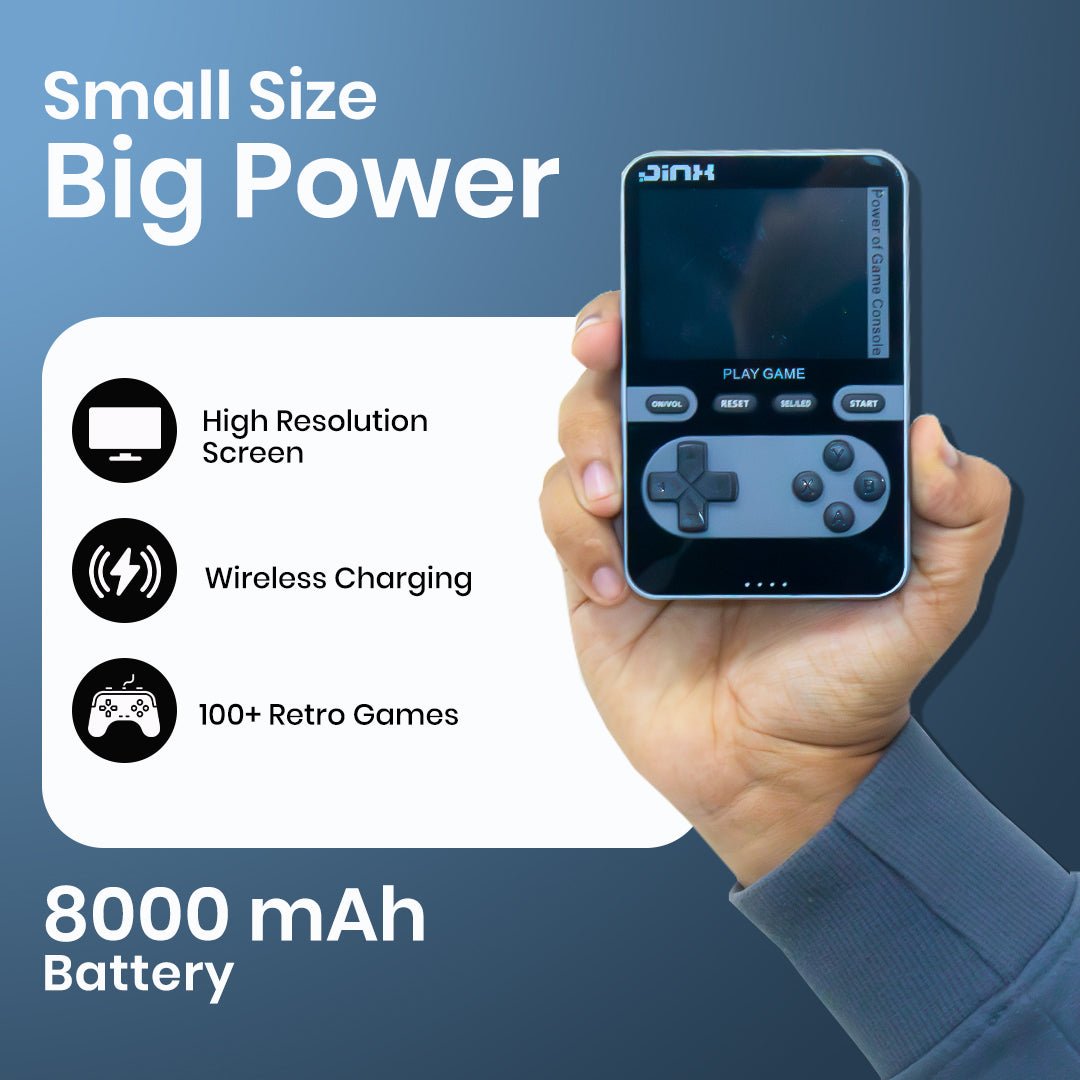
That last one is why the Alpha Pro has a hundred retro games built into it. 8000mAh, 15W MagSafe, 22.5W over Type-C, and twenty minutes that are no longer dead time.
By JINX Team